SCHOENSTATT SCOTLAND – 19THMAY 2019
CROWNING OF THE IMAGE OF OUR LADY
How do you approach the reading of a book? Do you start from page 1, or even the earlier pages which sometime prepare you for the actual text?
Or do you turn to the back, to see how the text concludes, not I suppose if it is a Who done it? Crime novel. That would spoil the plot!
Or do you open it at random, particularly if it is a series of essays, or e.g. a Biography, where the sequence of events allows you to read forward or backwards (- if you see what I mean…!)?
What about the Bible? After all it is composed of different books. Are we expected to read it from the beginning? From the end? From the New Testament backwards? From the Epistles to what they comment on? Approaching it all as if it were history? Treating it as a great story, or dare I suggest it a boring account of events no longer having relevance to our own times?
I imagine that many who read the New Testament are not so familiar with the Old Testament. I remember my Mother asking me after hearing some rather uninteresting passage from the history of Israel, what was the point of “raking up the past”?!
A Catholic theologian whom I knew as a lecturer at Aberdeen University wrote a book entitled “The Comedy of Revelation”. She was not thinking of TV amusement programmes. She was rather using the word “Comedy” as used by the great Italian Poet, Dante, in his Magnum Opus, “The Divine Comedy”, meaning “life, or an event in it, regarded as a spectacle.” A meaning given among dictionary definitions of the word.
The sub-title of Francesca Murphy’s book is “Paradise Lost and Regained in Biblical Narrative”. She
explains that the typical scholarly approach to the study and reading of Scripture over recent times has concerned itself with its historicity. She said that enlightenment modes of history (following on from the rational approach of 18thand post 18thcentury scholarship) led to endless vexation over the question “is this what actually happened?” to the detriment of an understanding of Israel’s sense of Yahweh. “One way of avoiding the pitfalls of what is called narrative criticism is to replace the metaphor of the Bible as a story with that of the Bible as a drama”. If we approach scripture in this way we will see each of the books like an act in an amazing revelation of God’s dealing with human kind, through narrative, history, prophecy, instruction, poetry and song –remember that the Psalms are songs. We need to enter the Drama, for we are part of it!
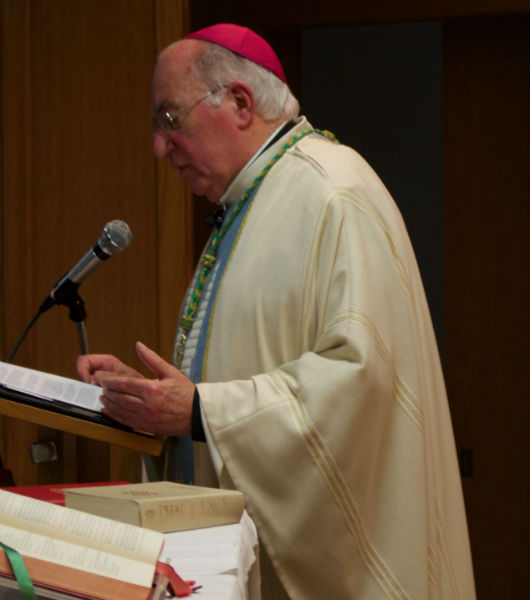
The success of all Drama is in its presentation and the presence of an audience. Here the great Liturgy of the Catholic Church comes to our aid. Today is but a small, but lovely, example of it. After hearing Readings from the New Testament: the Acts of the Apostles, the Apocalypse or Book of Revelation, and the Gospel of John, we re-enact what Our Lord did at the Last Supper, and to conclude today’s Mass we forma a procession and go to honour the image of Our Blessed Lady, Trice Blessed, in her shrine in this Lovely Place.
All of this is an act of Faith and Devotion. We enter the Drama, associating ourselves with the truth of what we celebrate, and show our love in a particular manner for the Mother of Our Saviour.
The Truth of what we celebrate is provided for us in the sacred Readings from the Old and New Testaments given within the first part of the Mass. During this holy season of Easter, all three are taken from the New Testament, and the first of them today (5th Sunday of the Easter Season, Year C) is from the Acts of the Apostles. It records how Paul and Barnabas, having been sent by their fellow Apostles, following an intervention of the Holy Spirit, to preach the good news in an area of Asia Minor, now Turkey, returned to tell them how successful their mission had been: “On arrival they assembled the church, and gave an account of all that God had done with them, and how he had opened the door of faith to the pagans”.
The passage from St. John’s Gospel reminds us what was at the heart of their preaching: “Now has the Son of Man been glorified” Jesus had said, “I give you a new commandment, love one another just as I have loved you. By this love…everyone will know that you are my disciples”.
It is perhaps the second Reading from the book of the Apocalypse which is most apt for our present celebration, since, as the last book of the Bible it gives us a vision of what is still to come: “I John saw a new heaven and a new earth…I saw the Holy City, and the new Jerusalem, coming down from God out of heaven as beautiful as a bride all dressed for her husband…Here God lives among men; He will make his home among them.”
What are we talking about? Is it heaven? Or the Church on earth? Both, for where God is, is heaven. “Ubi Charitas et amor, Deus ibi est” (Where there is Charity and Love there God is)- as we sing in the Liturgy of Holy Week. However we are still short of the full reality here on earth. It is, as we would say today, a work in progress! We live in hope of its fulfilment.
But the reference to the Church as bride all dressed for her husband, brings to our mind the great sign in the heavens given to John in the Apocalypse, The Book of Revelation: “Now a great sign appeared in heaven: a woman adorned with the sun, standing on the moon, and with the twelve stars on her head for a crown.. The woman brought a male child into the world, the son who was to rule all the nations”. The commentary to the Jerusalem Bible says: “The woman is essentially an image of Israel as the mother of the messianic saviour. The woman’s pain in travail may recall the curse of Eve, whose offspring would ultimately wound the serpent”.
So the last book of the Bible brings us back to the first book, Genesis, where God curses the serpent who has tempted the woman: “I will make you enemies of each other: you and the woman, your offspring and her offspring. It will crush your head and you will strike its heel”.
Not without reason does the Church also see prefigured in this promise Mary the Mother of Jesus, Mother of the saviour of mankind. The doctrine of her Immaculate Conception confirms the role of Mary in the plan of God. The grace of her sinlessness in her very conception, the “fullness of Grace” of the Angel’s greeting, proclaims the victory over sin, the harbinger of death, achieved on the cross by the sacrifice of Jesus. And there stood at the cross of Jesus Mary his mother: “Stabat Mater iuxta crucem”, and Jesus said to John, the beloved disciple “behold your mother”.
The holders of the Catholic faith, both East and West, and wherever now dispersed, (- and also within the Islamic faith), honour her with a tender devotion, as we do here today at Schoenstatt, and place on her head the crown of our love.